
My loves,
I am writing to the part of you that still flinches when you hear the word “church.” The part that loved Jesus, or at least the Jesus you met in the Sermon on the Mount, yet walked away from the institution that spoke his name while wounding your body, your sexuality, your intuition, your mind.
Mary Magdalene sits exactly in that torn place.
When I read The Gospel of Mary, I do not see a quiet, passive woman orbiting male authority. I see the one who stands up in the room after the men collapse. After their Savior departs, the disciples are undone.
They weep.
They panic.
They fear persecution.
Mary rises and says, “Do not weep and be distressed nor let your hearts be irresolute… his grace will be with you all and will shelter you.”
She did what the institution later refused to do.
She looked trauma in the face and refuses to let despair have the last word.
Karen King calls attention to how this text presents Mary as the one who steadies the community and carries forward the teaching as a central theological voice whose authority provokes male resistance. When I sit with that, I see every woman, queer person, survivor, or spiritually hungry soul who has had to become their own priest after the church failed them. I see you, standing up inside your own life and saying: I will not let this story end in fear.
Mary’s healing begins here, in the refusal to confuse institutional fragility with divine absence.
In The Gospel of Mary, sin is not described as an inherited stain. Jesus says, “There is no such thing as sin; rather you yourselves are what produces sin when you act in accordance with the nature of adultery.” King reads this as a radical reframing of moral failure: sin emerges from distortion, ignorance, misalignment, not from the mere fact of being human.
If you grew up inside purity culture, or under preaching that weaponized shame, this matters.
The problem was never your body.
The problem was never desire itself.
The wound sits in the systems that taught you to mistrust your own interior knowing, then demanded obedience to external law.
In the same passage Jesus warns them not to go out and “promulgate law like the lawgiver,” because if they do, they will be dominated by it. The text itself names what so many of us have experienced: law that was supposed to protect became the mechanism of harm.
Mary heals that wound by calling us back to the “child of true Humanity” within. She si not talking about a distant, punitive God that someone else interprets for you, but a presence rooted in your own mind, your own capacity to see, to discern, to know.
She invites a spirituality where authority moves inward, where you no longer hand your soul to an institution that has shown you it cannot hold it with care.
Of course, the moment Mary speaks resistance comes.
Peter questions whether the Savior really spoke these words to a woman. He doubts her. He calls her teaching strange. Andrew joins him. Mary weeps. Then Levi steps in and names what is happening: “If the Savior made her worthy, who are you then for your part to reject her?”
The conflict here is not a side note. King and other scholars point out that this scene exposes fault lines in the early movement about women’s leadership, revelation, and authority.
What the later church did with Mary mirrors Peter’s anxiety more than Jesus’ trust. For centuries, Western preaching conflated her with the unnamed “sinful woman” of Luke 7 and Mary of Bethany, then labeled her a repentant prostitute, a reading that solidified after Pope Gregory I’s influential homily in the sixth century.
So the institutional church took the woman Jesus trusted with resurrection witness and visionary teaching, and wrapped her in a story of sexual shame. That misidentification has shaped how women are seen: either pure vessels or polluted bodies. Scholars, journalists, and theologians have traced how stubborn this distortion has been, even after the official clarification in the twentieth century.
If you ever felt as if your body made you dangerous in church spaces, you are not imagining the weight of that story.
Mary heals this wound by refusing to disappear.
Her own gospel preserves the moment she is told, in effect, to sit down and be quiet, and also preserves her refusal to collapse into self-doubt. Her tears in the text feel familiar to me. They feel like the tears of anyone who dared to speak spiritual truth from a marginalized body and then felt the room turn cold.
Yet the narrative ends with Levi affirming her and the group going out to preach. Her voice, not Peter’s suspicion, frames the sending. The community moves forward under the imprint of a woman’s teaching.
For those of us carrying “church wounds,” Mary becomes an icon of spiritual authority that will not hand itself back to the gatekeepers who tried to discredit it.
When I turn from The Gospel of Mary to Thunder, Perfect Mind, I begin to hear the larger chorus of the Dark Feminine that my own dissertation lives inside.
In Thunder, a divine voice speaks in paradox:
“I am the honored and the scorned.
I am the harlot and the holy one.
I am the wife and the virgin.”
Hal Taussig and his colleagues describe this poem as an ecstatic self-portrait of a feminine divine figure who gathers up contradictions in herself instead of resolving them into a neat category. She is shame and boldness, war and peace, wisdom and ignorance, “peace and because of me war has come to be.”
If the church wound taught you that your complexity was a threat, Thunder speaks to that place deep withinin your bones, in your soul. The voice refuses the madonna/whore split that has haunted Mary Magdalene’s story in Western imagination. It refuses to let purity be defined against embodied life.
Read Thunder beside the Magdalene and something inside your soul shifts.
The woman who was branded a prostitute by patriarchal preaching stands next to a divine voice that names herself both harlot and holy. The slur is emptied of its power.
Sexualized insult is folded into sacred self-description and turned into a site of revelation rather than disgrace.
In psychological work on archetypal feminine figures, Mary Magdalene often appears as a symbol of the wounded-yet-healing feminine, bearing both erotic energy and spiritual depth, a figure of sacred partnership and transformation for those harmed by rigid spiritual systems.
When you have survived purity culture, assault, spiritual gaslighting, or the slow erosion of your voice in church settings, this reflects in your nervous system.
You need more than a doctrinal correction.
You need a God-image who looks like a woman whose story was twisted, yet who still stands, still loves, still speaks.
A God-image who says: I know what it is to be misnamed by religious men and I am still here.
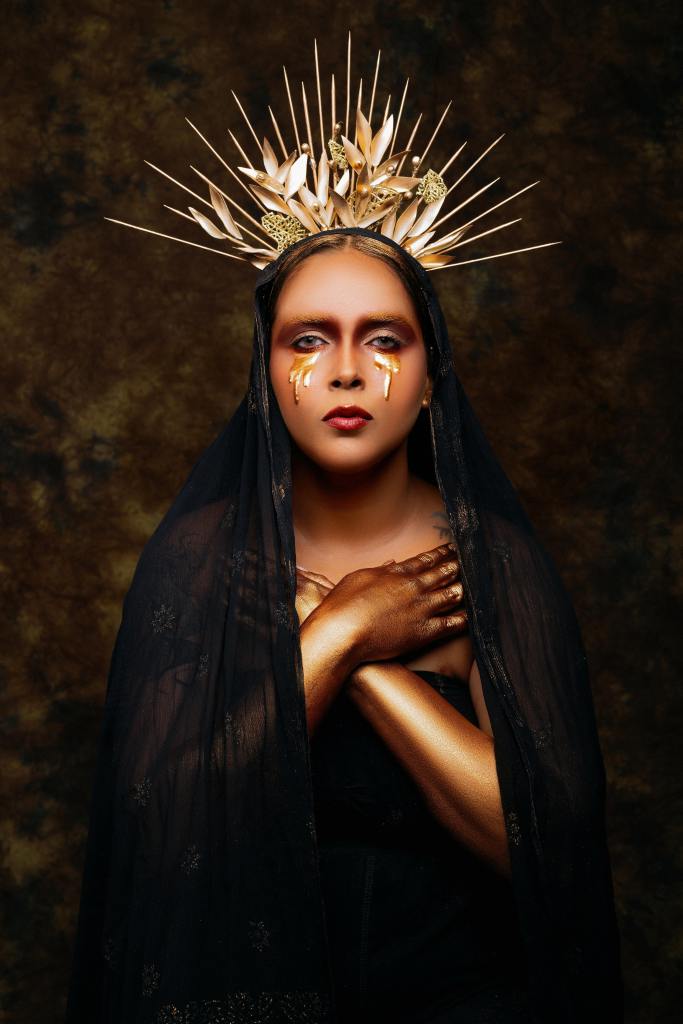
Mary Magdalene, read through the lens of Thunder, becomes such an image.
In my own work on the Dark Feminine, I have come to see figures like Mary Magdalene, Hekate, and other liminal goddesses and saints as companions for those who are leaving, questioning, or rebuilding after religious trauma. Mary bears the marks of institutional violence in her story, yet she remains tethered to the healing presence of the sacred.
She does not require you to choose between Jesus and your own safety.
Instead, she meets you at the crossroads.
She understands what it means to love a teacher whose followers fail to embody his teaching.
She understands what it feels like to be reduced to a rumor by the very tradition that preserved your name.
In The Gospel of Mary, Jesus blesses the disciples with peace and warns them against new legalism. Mary carries that peace into a frightened room. She reminds them that grace shelters them. She turns their hearts “toward the Good” when fear might have driven them back into structures of control.
In Thunder, the divine feminine voice refuses to be exiled from the garbage heap of human contempt.
“Do not look upon me on the garbage-heap and go and leave me discarded. And you will find me in the kingdoms.”
When you feel as if leaving the church has discarded you on the spiritual garbage heap, Mary Magdalene and the voice of Thunder whisper together: Divinity is not confined to the sanctuary.
You will find me among the ones you were told to discard, including the discarded parts of yourself.
So how does Mary heal the wounds the church leaves behind?
She does it by untangling Jesus from the machinery that hurt you.
She does it by modeling a spirituality rooted in inner vision, where the mind that sees God is the place of encounter, not the hierarchy that polices your access.
She does it by exposing, inside the sacred story itself, the misogyny and suspicion that have always stalked women’s voices, then showing another way forward.
Mary does not ask you to forget what happened. She stands beside you as you find your spirtual footing. In the framework of the Dark Feminine, this anger is not an obstacle to holiness.
It is sacred information.
It is the eruption of your soul refusing to participate in its own diminishment.
Mary heals this wound slowly.
Through scripture that shows her as first witness, first preacher, and teacher of hidden revelation.
Through apocryphal texts where she speaks of ascent and liberation from ignorance.
Through the way she keeps returning in our time as an icon of fierce, tender, embodied holiness.
If you carry church scars, you do not need to squeeze yourself back into the shape that harmed you in order to be “spiritual” again.
You can sit with Mary.
You can let her stand up in the frightened room of your heart and say: Do not let your heart be irresolute.
Grace will shelter you.
The Good is still here.
And then, when you are ready, you can walk out of the old doors accompanied by a woman the church tried to misname, who became instead a healer for those who left.
With you at the crossroads,
Mary’s friend at the margins
Further Reading
- Karen L. King, The Gospel of Mary of Magdala: Jesus and the First Woman Apostle (Polebridge Press, 2003). A foundational scholarly study of the text, its manuscript history, and its portrayal of Mary as an authoritative teacher whose voice contests patriarchal control in the early movement. Internet Archive+1
- Karen L. King, “Translation of the Gospel of Mary” (Rosicrucian Digest reprint). Accessible English translation of the surviving Coptic text, including the scenes of Mary comforting the disciples, her visionary teaching, and the dispute with Peter. b1abf303159370a4cfaf-c1816428c4ec85ce3e001bf1f2b5d8cd.ssl.cf5.rackcdn.com+1
- Hal Taussig et al., The Thunder: Perfect Mind: A New Translation and Introduction (Palgrave Macmillan, 2010). Offers a carefully annotated translation of Thunder and multiple essays on its portrayal of a paradoxical feminine divine voice that holds together shame and glory, whore and holy. ThriftBooks+1
- Anne McGuire’s translation of The Thunder: Perfect Mind on Diotíma: A reliable online version of the text, with the “I am” statements that have become central to many feminist and goddess-centered readings. Diotíma+1
- Scholarly work on Mary Magdalene and the feminine divine in contemporary psychology and theology, for example S. Bond’s dissertation on archetypal divine feminine figures and Mary as a symbol of sacred partnership and healing. Digital Commons
- Historical and theological analyses of Mary’s misidentification as a prostitute and the long work of correcting that narrative, including discussions of Gregory the Great’s homily and modern feminist retrieval of Mary as “apostle to the apostles.”
With love,
-A

 Red Thread Letters
Leave a comment